Attendance tracking for BJJ academies: from clipboard to automatic
A practical guide to attendance tracking for Brazilian jiu-jitsu and martial arts academies — why the clipboard fails, what to measure, and how class-level check-in data powers capacity planning, promotions, and revenue.
Why the clipboard fails
The clipboard at the front desk feels like attendance tracking, but it almost never produces usable data. Members forget to sign, the sheet gets full and replaced, nobody types it into anything, and three months later there's no way to answer a basic question like 'how many people came to Tuesday no-gi in April?'
The failure isn't laziness — it's that a paper record has no second life. Data you can't query is data you don't have. The whole point of attendance tracking is the questions you ask later, and a clipboard can't answer any of them. Automatic check-in solves this by making the act of recording attendance and the act of arriving the same action.
What to actually capture
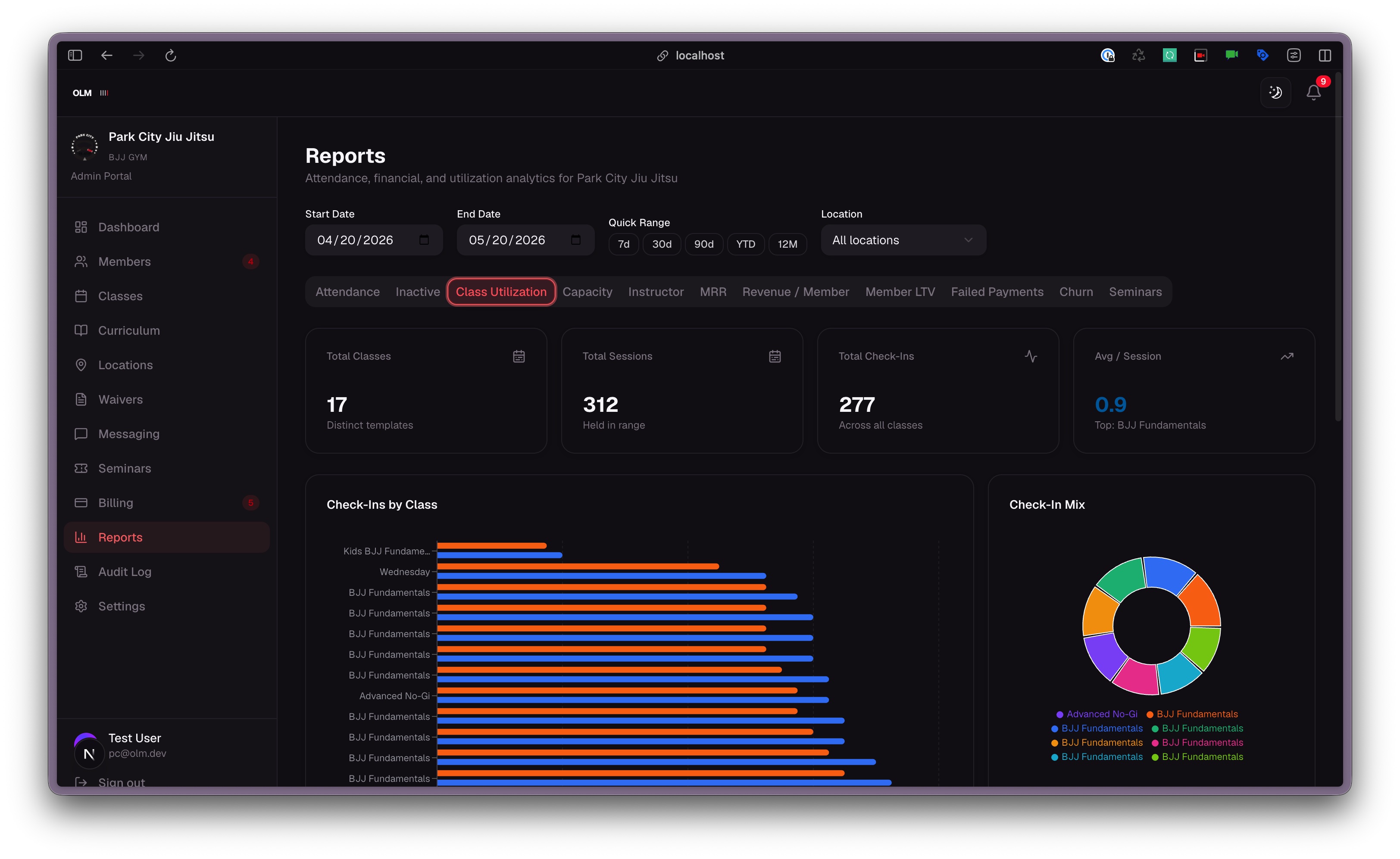
Good attendance data has three properties: it's per-member, per-class-session, and timestamped. 'Forty people trained this week' is nearly useless. 'These specific members checked into these specific class sessions at these times' answers almost any operational question you'll ever have.
- Who: the individual member, so you can see per-person frequency and spot fades.
- Which class: the specific session (Tuesday 6pm no-gi), not just the day, so utilization is real.
- When: a timestamp in your gym's timezone, so reporting doesn't drift across daylight saving or admin location.
Capacity planning: which classes to add, cut, or move
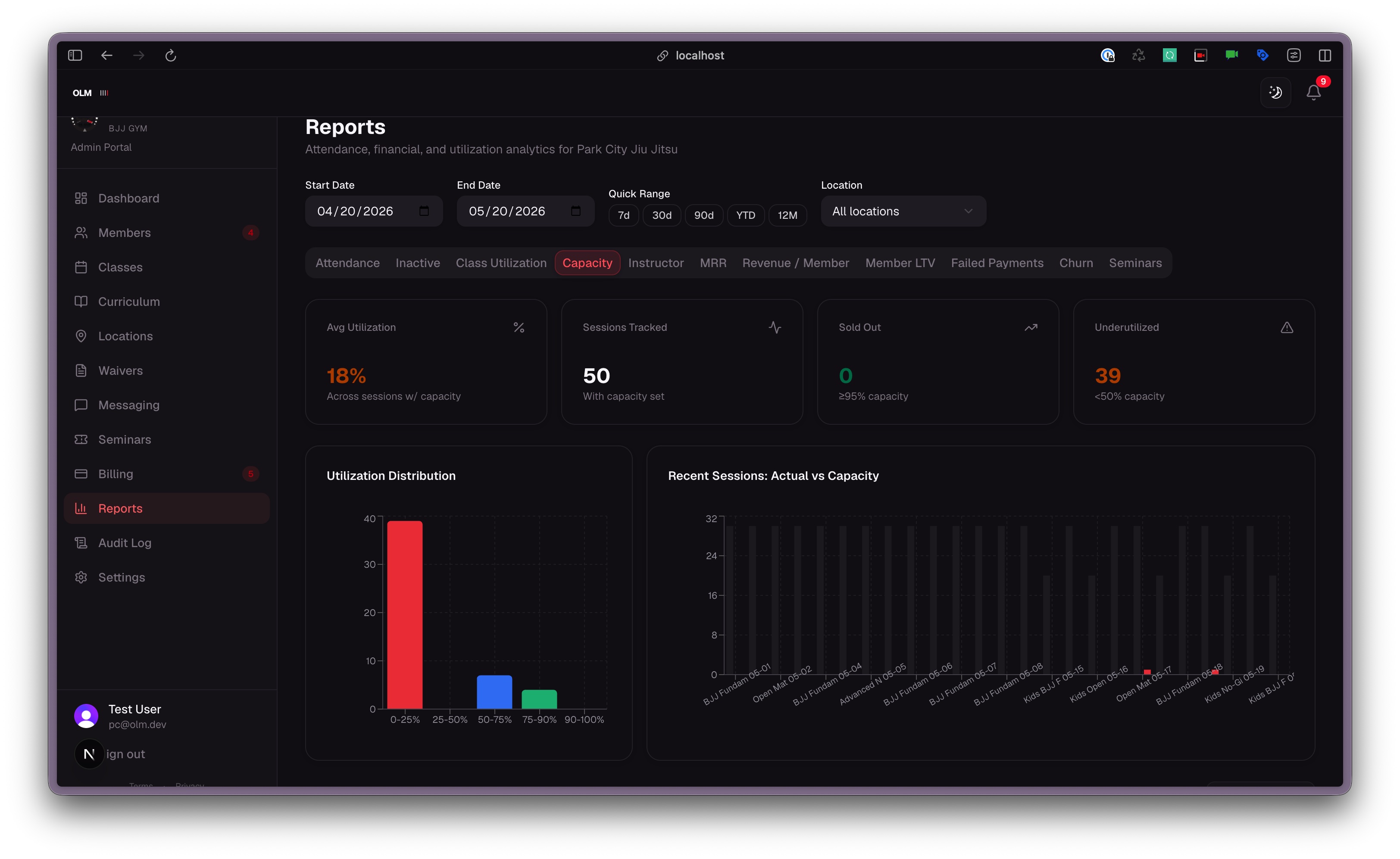
Once attendance is per-session, capacity planning stops being a guess. A utilization report shows you which classes are bursting (candidates for a second session or a bigger mat rotation) and which are consistently under-attended (candidates to move to a better time or cut entirely).
This matters more for martial arts than for boutique fitness because mat space and coach attention are the constraint. A no-gi class running at 140% of comfortable capacity is a safety and experience problem; a fundamentals class running at 20% is a coach's evening you could redeploy. You can only make those calls if you're measuring attendance against the session, not in aggregate.
Promotions: attendance is the honest input
Belt promotions in BJJ are part judgment, part mat time. The judgment is yours; the mat time is data you should not be estimating from memory. Attendance history gives you an honest record of how often a member has actually trained since their last stripe or belt — which is exactly the context you want in front of you when you're deciding who's ready.
It also protects you from the recency bias of promoting whoever's been around lately. The quiet member who trains four mornings a week without fanfare shows up clearly in attendance data, even if they're not the loudest presence in the room.
The revenue connection
Attendance and revenue are tied tighter than most owners track. Members who train regularly renew; members who fade cancel. So your attendance trend is a leading indicator of next quarter's revenue, weeks before it shows up in failed payments or cancellations.
There's also a direct line for drop-ins and seminars: every drop-in check-in is a transaction, and attendance at a seminar is the headcount you're billing. When check-in and billing run on the same system, the headcount and the revenue reconcile automatically instead of being two numbers you hope match.
Going automatic
The move from clipboard to automatic isn't a big project. Put a tablet at the front desk in kiosk mode, print a QR code for the wall, point members at the app, and the data starts accumulating from day one. Within a few weeks you have enough history to read utilization and frequency; within a couple of months it's a genuine retention and planning tool.
The clipboard's only real advantage was that it required no setup. Automatic check-in requires a little — and then quietly produces the one dataset every other decision in your academy depends on.
Free tool
Free class schedule widget for your website
Embed a live, always-current class schedule on your gym's site — so prospects answer “what time are classes?” themselves instead of waiting on a DM reply.
Get the widgetTry OLM
White-labeled software for martial arts academies. $0/mo, pay only when you collect.
Create your account